Initial Renderings Revealed for the Global War on Terrorism Memorial Planned for the National Mall

Summary
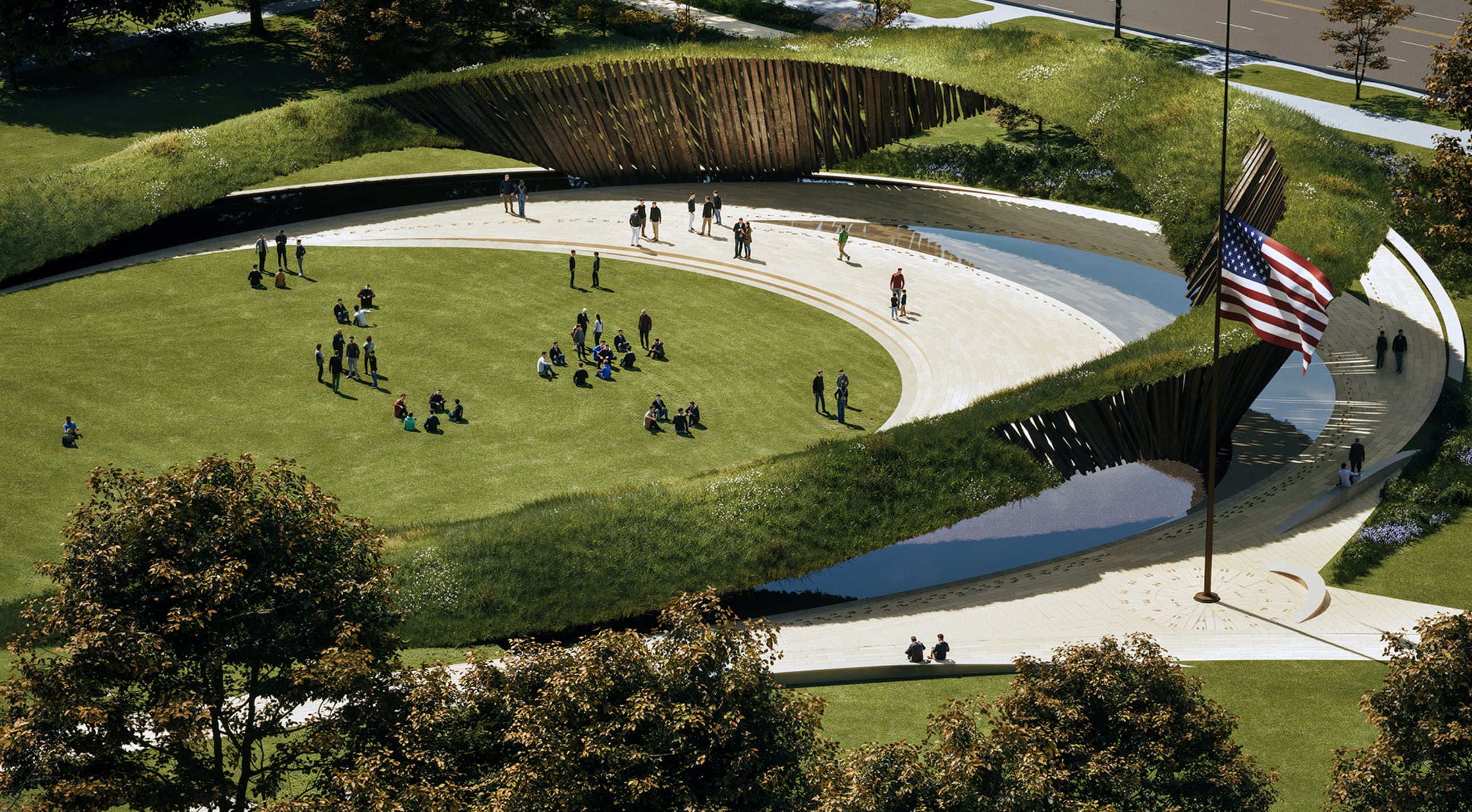
The Global War on Terrorism Memorial Foundation has released the first visual renderings of the planned memorial to be constructed on Washington's National Mall, designed by renowned architect Kengo Kuma. The design emerged from eight years of community input involving approximately 20,000 Americans, including veterans from all military branches, and features three entrances marked by steel and stone artifacts recovered from the September 11 attacks. A centerpiece of the memorial is a classically inspired amphitheater called "the embrace," which incorporates an arch made from reclaimed combat-era steel, adorned with native vegetation, and deliberately aligned with Section 60 of Arlington National Cemetery, where roughly 1,000 post-9/11 war veterans are buried. A marble "path of honor" embedded with boot prints connects to adjacent National Mall memorials and leads to shallow reflecting pools where visitors can physically interact with the space, symbolically walking alongside fallen loved ones. The foundation is currently pursuing design approvals from city planning commissions, with a groundbreaking targeted for 2027 and project completion anticipated by late 2028.
Key Takeaways
- 1. Architect Kengo Kuma designed the memorial with deeply personal motivation, having lost a close friend in the September 11 World Trade Center attack
- 2. The memorial's design was shaped by input from 20,000 Americans over eight years, including a 23-member advisory council of Gold Star families and veterans
- 3. Key physical elements include reclaimed 9/11 steel artifacts, a combat-steel arch aligned with Arlington National Cemetery, and an interactive marble path with boot print engravings
- 4. Shallow reflecting pools provide an interactive experience, inviting visitors to leave their own footprints as a symbolic gesture of connection with those who served
- 5. The project timeline includes finalizing design approvals in the coming months, a 2027 groundbreaking, and a completion target of late 2028