US Marine Corps Seeks Robotic Solutions for Constructing Forward Operating Airstrips

Summary
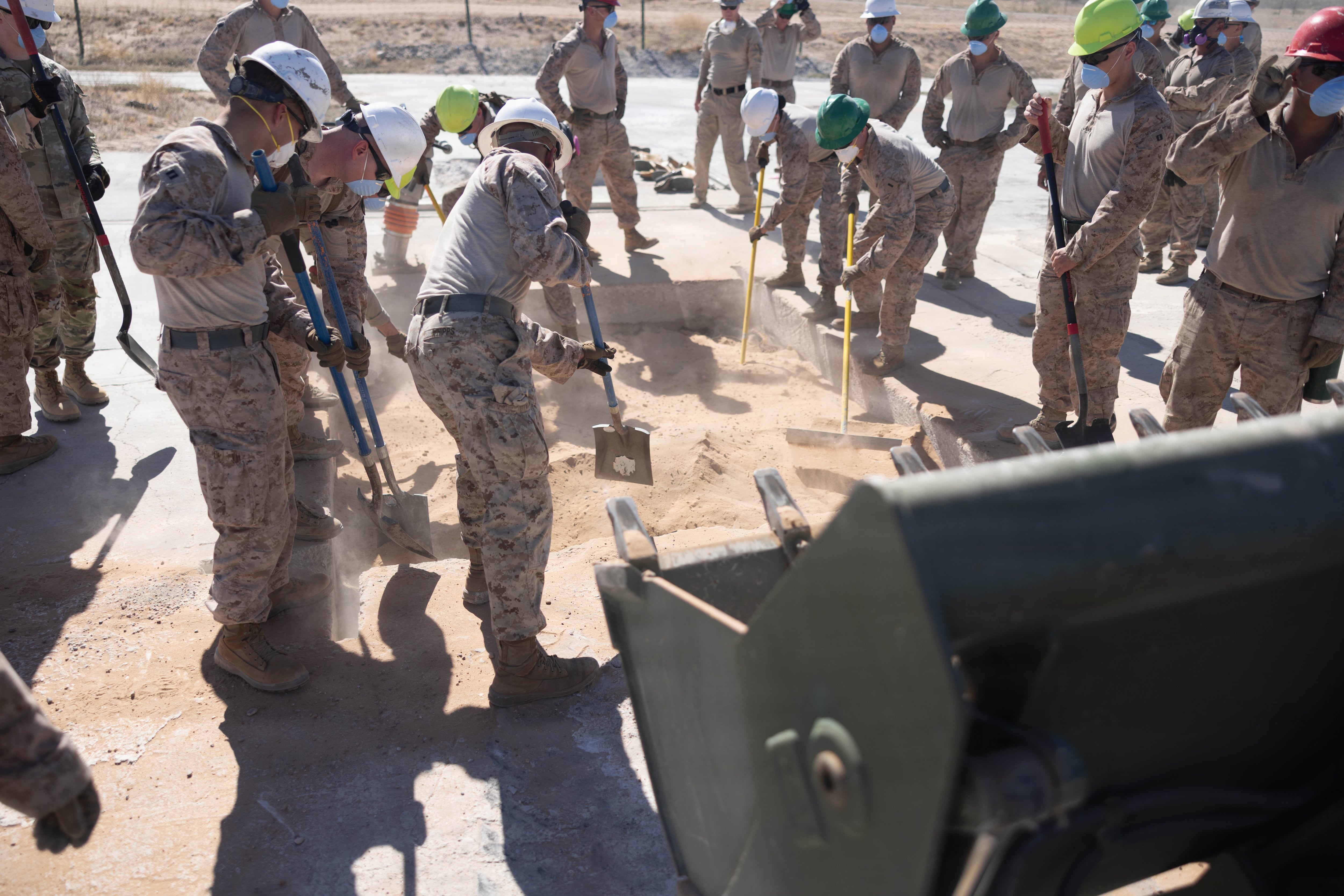
The United States Marine Corps is pursuing the development of autonomous robots to replace the physically demanding and hazardous manual labor involved in assembling Expeditionary Airfields (EAF) in remote and challenging environments. Through a Small Business Innovation Research (SBIR) proposal, the Corps is seeking robotic systems capable of navigating unstable terrain, handling heavy aluminum matting with precision, and operating independently with features such as obstacle avoidance and path planning. The project is structured in three phases: Phase I focuses on proving technical feasibility, Phase II requires a functional prototype capable of semi-automated or fully automated operations, and Phase III demands a field-deployable system hardened against electrical, environmental, and cyber threats. The robots will be evaluated on multiple performance metrics including payload capacity, manipulation precision, power consumption, and operational endurance, with an overall goal of significantly reducing manpower requirements, operational costs, and deployment time. This initiative aligns with broader Marine Corps efforts to modernize expeditionary airfield construction, coinciding with growing industry development of construction-capable robotic platforms.
Key Takeaways
- 1. The Marine Corps is using the SBIR program to source robotic technologies that can automate the labor-intensive assembly of expeditionary airfield matting
- 2. Required robots must be capable of autonomous navigation, obstacle avoidance, and precise manipulation of heavy materials across harsh and uneven terrain
- 3. The development program follows a structured three-phase approach, progressing from feasibility demonstration to prototype development to field-deployable systems
- 4. Final robotic systems must be hardened against electrical, environmental, and cyber threats to ensure reliability in combat or austere deployment scenarios
- 5. The initiative reflects a wider military and commercial trend toward using advanced robotics, including humanoid and quadruped robots, for physically demanding operational tasks