Deployment of India's Fourth S-400 Unit Creates Uninterrupted Air Defence Coverage Along Western Border
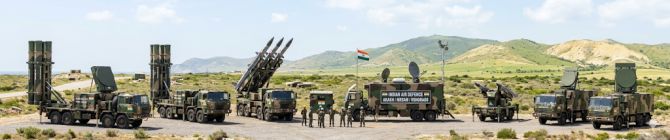

Summary
India has deployed its fourth S-400 Triumf air defence squadron along the Punjab and Rajasthan sectors, specifically targeting longstanding vulnerabilities in the western plains where flat terrain has historically allowed enemy drones, cruise missiles, and standoff weapons to penetrate radar coverage. The S-400's advanced 91N6E radar system extends surveillance deep into Pakistani territory, fundamentally transforming border defence dynamics by providing early warning and tracking capabilities at unprecedented range. Rather than depending on a single system, India has constructed a sophisticated multi-layered air defence architecture that integrates the S-400 at its apex with complementary systems including Project Kusha, MR-SAM, and SAMAR, ensuring that threats evading one tier are neutralised by successive layers. The deployment carries additional strategic significance as it coincides with the anniversary of Operation Sindoor, during which the S-400 was validated in live combat against Pakistani missiles, enabling the Indian Air Force to refine engagement protocols against hybrid threats like swarm drones and loitering munitions. Upon delivery of the fifth and final squadron in 2026, India will have established a near-continuous defensive perimeter stretching from the Karakoram to the Rann of Kutch, supported by an automated command and control loop integrating Russian, Israeli, and Indian systems.
Key Takeaways
- 1. The fourth S-400 squadron directly addresses critical geographic vulnerabilities along India's western front, where flat terrain previously compromised radar coverage and border defence effectiveness
- 2. India's multi-tiered air defence architecture integrating Russian, Israeli, and indigenous systems will create one of the world's most sophisticated defensive airspaces by 2026, making penetration extremely difficult for adversaries
- 3. Operational experience gained during Operation Sindoor has provided the IAF with invaluable real-combat data to refine engagement protocols against emerging hybrid threats including swarm drones and loitering munitions
- 4. The India-Russia defence partnership demonstrates strategic resilience, with rupee-rouble payment mechanisms successfully insulating critical defence procurement from Western sanctions pressure
- 5. India's parallel development of indigenous systems including Akash-NG, Astra BVR missiles, Barak-8, and a maturing Ballistic Missile Defence programme signals a long-term strategy to reduce dependency on foreign platforms while building a comprehensive layered defence ecosystem