POF's Shahed-Inspired Kamikaze Drone Exposes Pakistan Army's Long-Range Strike Ambitions

Summary
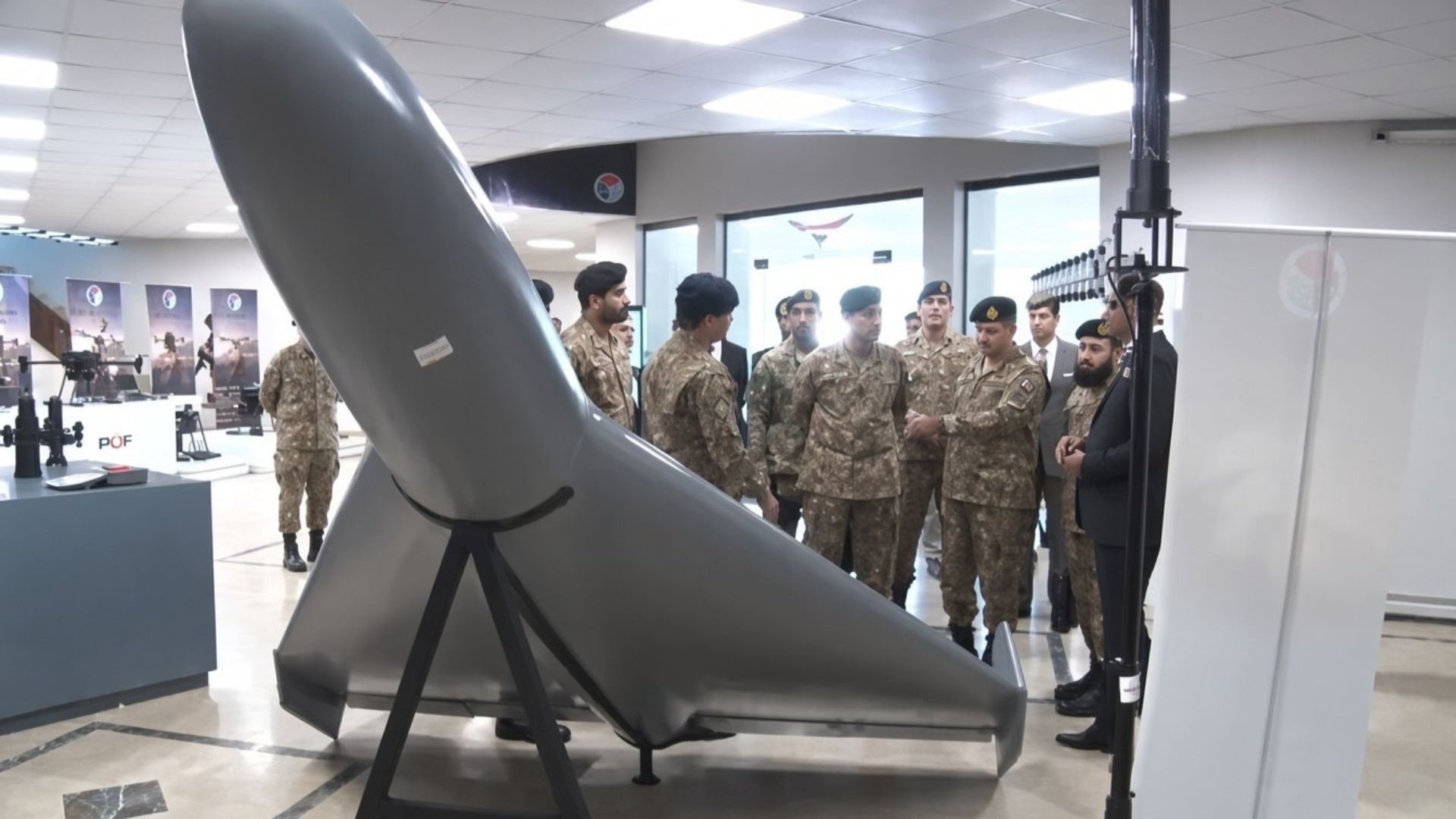
During a high-level visit by Pakistan's Chief of Army Staff Field Marshal Asim Munir to Pakistan Ordnance Factories (POF) on August 29th, a tailless delta-wing loitering munition conceptually similar to Iran's Shahed-136 was unveiled, marking at least the second such weapon system under development in Pakistan alongside Heavy Industries Taxila's D-248, which claims a range of 2,200-3,000 kilometers. These developments collectively signal that the Pakistan Army is strategically pursuing a long-range deep-strike capability centered on low-cost, piston-powered one-way-attack (OWA) drones with operational ranges of 2,000-3,000 km. Drawing inspiration from Russia, Ukraine, and Iran's mass-salvo warfare doctrines, Pakistan appears to be building toward large-scale stockpiling and wartime replenishment capacity, potentially requiring tens of thousands of units. Both state-owned enterprises like HIT and POF, as well as private sector partnerships such as Ukraine's Fire Point collaborating with Pakistani companies, are actively competing to fulfill this apparent military requirement. The newly established Defence Industrial Production and Regulatory Authority (DIPRA) is positioned to facilitate private sector participation in this production effort, suggesting a broader push toward domestic indigenization through technology transfers.
Key Takeaways
- 1. Pakistan is actively developing Shahed-136-style loitering munitions, with at least two programs underway across different defense entities, indicating a serious and coordinated deep-strike strategy
- 2. The Pakistan Army's desired strike range of 2,000-3,000 km suggests targeting capabilities well beyond immediate regional adversaries, reflecting significant strategic ambition
- 3. Pakistan is adopting a mass-salvo warfare doctrine similar to that employed by Russia, Ukraine, and Iran, prioritizing quantity, low cost, and overwhelming volume over precision alone
- 4. Both state-owned enterprises and private sector companies are competing for what could be an enormous procurement contract, highlighting a competitive and diversifying Pakistani defense industrial landscape
- 5. DIPRA's establishment signals Pakistan's intent to systematically integrate private sector players into sensitive defense production, potentially accelerating indigenization and reducing dependence on foreign suppliers