Germany's Defense Surge Deserves American Applause and Recognition

Summary
Germany has undergone a dramatic and historic transformation in its defense posture, shifting from decades of constitutional restraint and chronic underspending to becoming NATO's most consequential European contributor. Driven by Russia's invasion of Ukraine and pressure from the Trump administration, Germany is doubling its defense budget within four years, with spending rising from 1.43% of GDP in 2021 to an estimated 2.69% by 2026, with a long-term target exceeding 3.5% of GDP by 2035. Beyond financial commitments, Germany has made a landmark strategic decision to permanently station a combat brigade in Lithuania, marking the first forward deployment of German combat forces in Europe since World War II, signaling a profound cultural shift toward accepting frontline deterrence responsibilities. Germany's powerful defense industrial base, anchored by companies like Rheinmetall, is also forming joint ventures with American firms to co-produce critical munitions such as 155mm artillery rounds and ATACMS missiles, strengthening both transatlantic industry ties and collective military capacity. The authors argue that as the "Axis of Aggressors" — China, Russia, Iran, and North Korea — deepens cooperation, the United States must value and support Germany's transformation rather than allow political disagreements to undermine this critical alliance momentum.
Key Takeaways
- 1. Germany is doubling its defense budget within four years, targeting over 3.5% of GDP by 2035, representing one of Europe's most significant military spending commitments
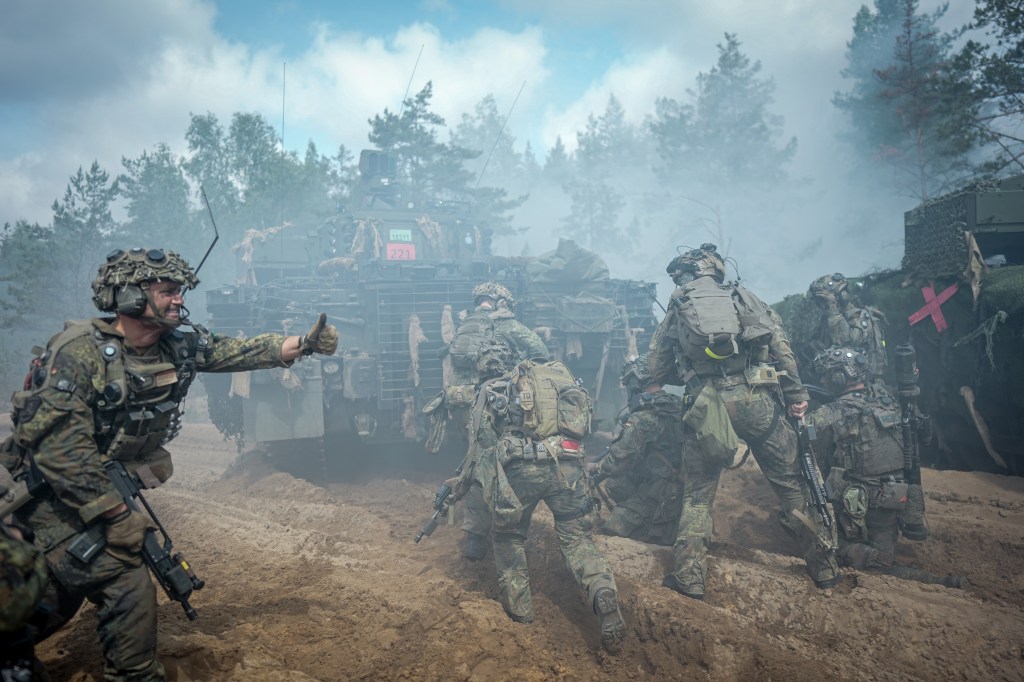
- 2. The permanent stationing of Germany's 45th Armored Brigade in Lithuania marks the first forward deployment of German forces in Europe since World War II, demonstrating a fundamental strategic cultural shift
- 3. Germany's €100 billion special defense fund, established in 2022, has accelerated procurement across air defense, armored vehicles, maritime, and cyber capabilities
- 4. German defense companies are forming industrial partnerships with American firms, including potential co-production of ATACMS missiles and 155mm artillery munitions, strengthening the transatlantic defense relationship
- 5. With China, Russia, Iran, and North Korea forming an increasingly coordinated "Axis of Aggressors," Washington should embrace rather than alienate Germany's growing defense contributions as a critical force multiplier