The Shifting Landscape of U.S. Research and Development Funding: From Government Dominance to Private Sector Leadership

Summary
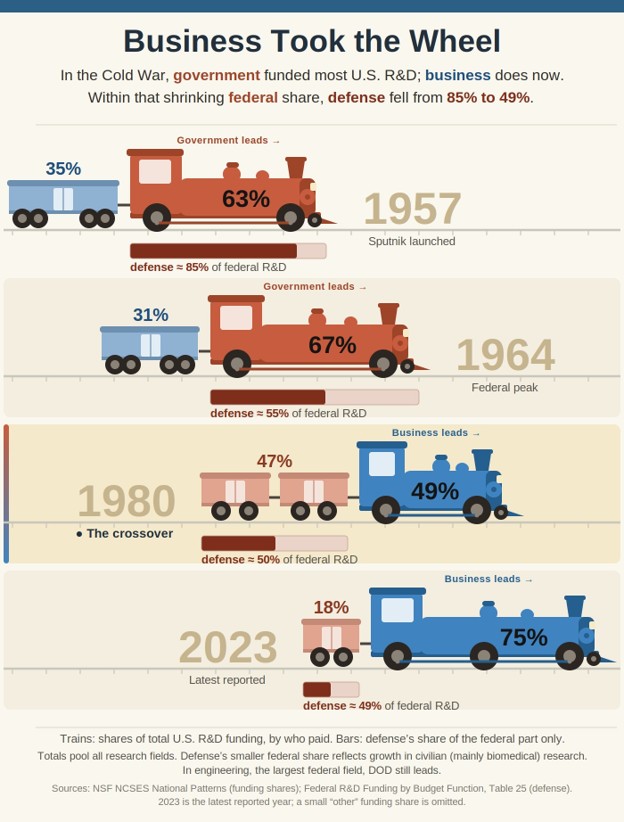
Following the Soviet Union's launch of Sputnik in 1957, the U.S. federal government served as the primary financier of American research and development, funding nearly two-thirds of the nation's R&D efforts, predominantly for defense purposes. Over the subsequent decades, this funding dynamic has undergone a dramatic reversal, with private industry now shouldering approximately three-quarters of U.S. R&D costs, while the federal government's contribution has diminished to less than one-fifth. This shift has fundamentally altered the Pentagon's role in technological innovation, forcing it to adapt and integrate commercially driven advancements rather than acting as the primary driver of cutting-edge research. Within the declining federal R&D budget, defense spending has also decreased as a proportion, falling from roughly 85 percent during the Sputnik era to approximately 49 percent today, largely due to a significant surge in civilian biomedical research funding through the National Institutes of Health. Notably, however, the Department of Defense remains the dominant funder specifically within the engineering sector, and when measured by who actually performs R&D work, industry's share rises even higher to approximately 77 percent, as companies also execute federally contracted research projects.
Key Takeaways
- 1. In 1957, the U.S. government funded nearly two-thirds of national R&D, primarily for defense, but today that share has fallen to less than one-fifth
- 2. Private industry now funds approximately three-quarters of all U.S. research and development, fundamentally inverting the Cold War-era funding model
- 3. The Pentagon has shifted from being a primary driver of technological innovation to a consumer and adapter of commercially developed technologies
- 4. Defense R&D as a share of total federal R&D spending has dropped from roughly 85 percent during the Sputnik era to approximately 49 percent today
- 5. The growth of civilian NIH biomedical research funding, rather than Pentagon retreat, largely explains the declining defense share of federal R&D spending