Pakistan, Saudi Arabia, and Türkiye Forge Trilateral Mutual Defence Pact in Makkah

Summary
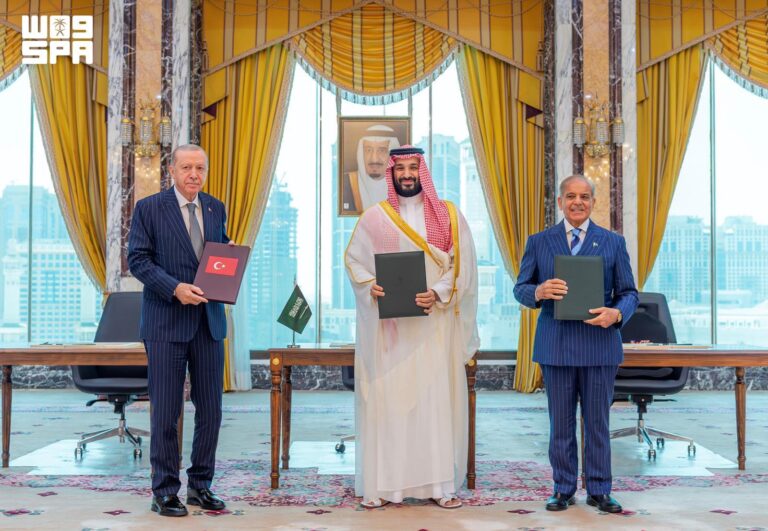
On 07 August 2026, Pakistan, Saudi Arabia, and Türkiye formalized a landmark trilateral security arrangement known as the Makkah Joint Defence Agreement, signed by their respective heads of state at Al-Safa Palace, establishing a collective defence commitment whereby an armed attack on any one signatory is treated as an attack on all three. The agreement also pledges enhanced cooperation across all dimensions of defence, with Pakistani officials crediting both Prime Minister Shehbaz Sharif and Field Marshal Asim Munir with facilitating the pact, which Islamabad characterizes as purely defensive and open to additional like-minded nations. All three parties have publicly emphasized that the agreement is not directed against any specific country, including Iran, and is not intended to form a sectarian bloc, military axis, or trigger a nuclear arms race. However, significant ambiguities remain unresolved, as the full treaty text has not been released, leaving key operational details — including geographic scope, ratification procedures, command structures, and whether collective response obligations are automatic or consultation-dependent — entirely unclear. The agreement was concluded against a backdrop of active regional conflict, with Saudi Arabia enduring repeated strikes from Iran-aligned forces targeting critical oil infrastructure and Vision 2030 projects, contextualizing the strategic urgency behind the pact.
Key Takeaways
- 1. **Collective Defence Architecture:** The agreement establishes an Article 5-style mutual defence clause among three significant Muslim-majority military powers, potentially reshaping regional security dynamics in the Middle East and South Asia.
- 2. **Strategic Ambiguity on Nuclear Dimension:** Despite Pakistani defence officials downplaying nuclear involvement, Saudi Arabia's characterization of the pact as encompassing "all military means" leaves open the question of whether implicit nuclear deterrence factors into the agreement's scope.
- 3. **Lack of Transparency Raises Operational Questions:** The absence of the full treaty text mirrors the pattern set by the September 2025 Pakistan-Saudi bilateral SMDA, raising concerns about accountability, parliamentary oversight, and the actual binding nature of collective response obligations.
- 4. **Geopolitical Context and Iran Factor:** Signed during active Iranian and Iran-aligned strikes on Saudi territory, the agreement carries clear strategic implications for regional power competition, even as signatories explicitly deny it targets Iran or any specific actor.
- 5. **Pakistan's Elevated Strategic Role:** The pact signals a significant enhancement of Pakistan's geopolitical standing, positioning it as a central security guarantor in a trilateral arrangement that spans the Gulf, Anatolia, and South Asia, with Field Marshal Asim Munir's prominent credit suggesting the military's decisive role in Pakistan's foreign policy direction.