Pakistan-Occupied Jammu & Kashmir: A Region Governed by Force Rather Than Democratic Will

Summary
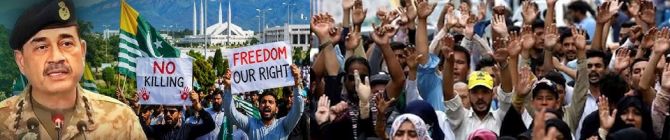
Pakistan's Defence Minister Khawaja Asif's declaration categorizing protesters in Pakistan-occupied Kashmir (PoK) as enemies equivalent to India has validated long-standing concerns about Pakistan's colonial treatment of the region's population. The Jammu and Kashmir Joint Awami Action Committee (JKJAAC), a grassroots coalition formed in 2023, emerged as a unified civil response to chronic economic grievances and governance failures, presenting a 38-point charter demanding basic rights such as subsidized wheat, reduced electricity tariffs, and removal of unconstitutional privileges enjoyed by politicians and bureaucrats. While Pakistan's PoK administration temporarily conceded to some demands in 2023 by restoring flour subsidies and freezing electricity tariffs, the lack of genuine political will led to recurring waves of protests in 2024 and 2025, demonstrating that structural issues remain unaddressed. Pakistan has responded to peaceful civilian dissent with brute military force, exposing the hollow nature of its claim that PoK represents "Azad" or free territory. The international community's continued silence on the violent suppression of PoK residents further compounds this ongoing humanitarian and political crisis.
Key Takeaways
- 1. Pakistan's Defence Minister openly labeling PoK protesters as "enemies" reveals the Pakistani state's fundamentally adversarial and colonial attitude toward the region it claims to protect
- 2. The formation of JKJAAC reflects deep-rooted civilian discontent, signaling serious governance failure and political instability within Pakistan's administered territories
- 3. Pakistan's use of military force against peaceful civilian protesters undermines its international narrative of being a legitimate stakeholder in the Kashmir dispute
- 4. India can leverage Pakistan's internal contradictions and oppression in PoK as a strong diplomatic and strategic argument in international forums regarding the Kashmir issue
- 5. The international community's apathy toward violence in PoK represents a significant gap in global human rights accountability, which India could strategically highlight to reshape the geopolitical narrative