Anduril Introduces Thunder Autonomous Attack Helicopter Designed to Operate Alongside the AH-64 Apache

Summary
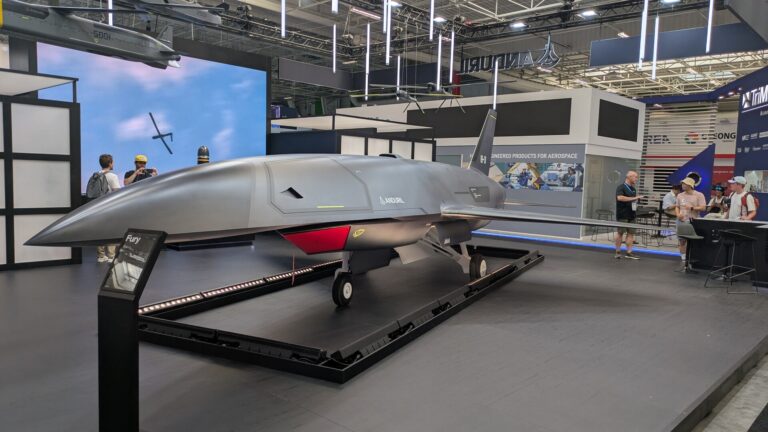
Anduril Industries, in partnership with Archer Aviation, has unveiled "Thunder," a Group 5 autonomous hybrid-electric tiltrotor attack rotorcraft at the 2026 Farnborough International Airshow, designed to serve as a loyal wingman for crewed attack helicopters such as the Boeing AH-64 Apache and the future Bell MV-75 Cheyenne II. The aircraft extends the manned-unmanned teaming (MUM-T) concept into Army attack aviation, responding to the growing vulnerability of crewed helicopters in contested environments where loitering munitions and low-cost air defenses — trends accelerated by the drone war in Ukraine — pose increasing threats to pilots. Anduril's core design philosophy centers on "affordable mass," arguing that fielding expendable autonomous platforms removes the catastrophic cost burden associated with losing an approximately $18 million crewed Apache, while simultaneously multiplying combat effectiveness. The company envisions deploying three to six Thunder aircraft per single Apache, potentially tripling available munitions for a Combat Aviation Brigade without increasing pilot risk, with each Apache crew commanding rather than directly piloting the autonomous wingmen. Thunder's weapons loadout is highly configurable, capable of carrying up to 10 missiles, 16 launched effects, or 76 rockets — including AGM-114 Hellfire and APKWS-class munitions — though the aircraft was displayed at Farnborough as a full-scale model rather than a functioning flying prototype.
Key Takeaways
- 1. **MUM-T Expansion into Army Aviation:** Thunder represents a significant doctrinal shift, bringing the loyal wingman concept — previously focused on fixed-wing fighter aviation — into rotary-wing attack operations, fundamentally changing how Combat Aviation Brigades may be structured and employed.
- 2. **Threat-Driven Development:** The design directly responds to battlefield lessons from Ukraine, where cheap drones and air defense systems have made crewed attack helicopters dangerously vulnerable in near-surface combat environments, signaling a broader rethinking of low-altitude attack doctrine.
- 3. **Affordable Mass as Strategic Concept:** By making autonomous platforms expendable and cost-efficient, Anduril challenges traditional military procurement logic, shifting risk away from highly expensive crewed platforms and enabling commanders to accept platform attrition as tactically acceptable rather than operationally devastating.
- 4. **Force Multiplication Without Additional Personnel Risk:** Pairing three to six Thunder units with a single Apache could multiply munitions capacity threefold or more for a given unit, offering significant combat overmatch without placing additional pilots in contested airspace.
- 5. **Early Stage Development Warrants Monitoring:** The fact that Thunder was displayed only as a full-scale model — not a flying prototype — suggests the system remains in early development stages, meaning its operational viability, reliability, and integration with Army command-and-control systems remain unproven and subject to significant future testing and procurement decisions.