Bayraktar Kızılelma Successfully Launches Roketsan's JET-230 Supersonic Missile, Striking Target at Over 120 km Range

Summary
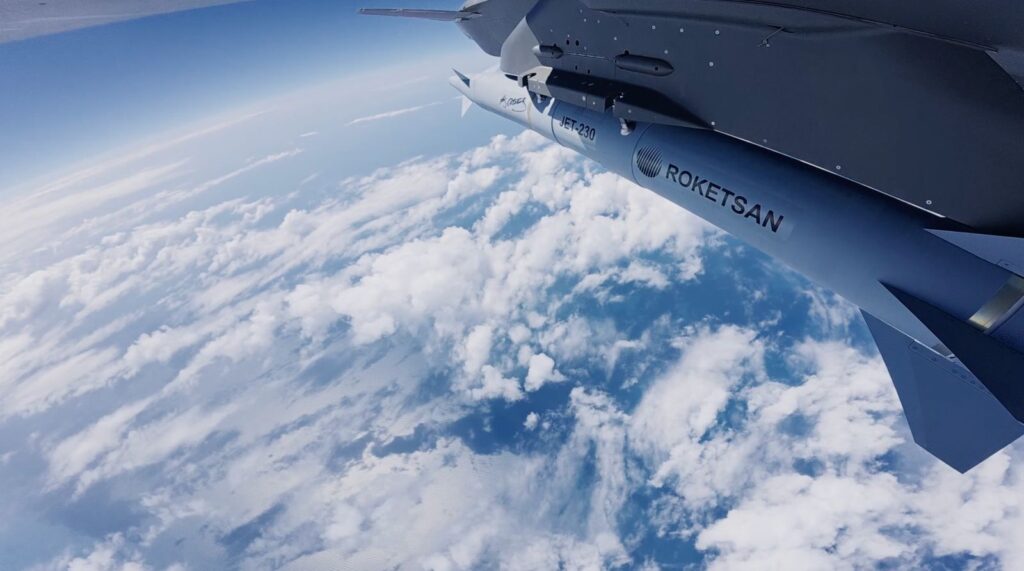
Turkey's Baykar announced on July 13 that its Bayraktar Kızılelma unmanned combat aircraft successfully fired a Roketsan JET-230 supersonic air-to-ground missile, achieving a precision "Bull's Eye" strike on a target located more than 120 km away, marking the drone fighter's first supersonic air-to-ground weapons test. Notably, the aircraft used in the test was a serial production airframe (S2) rather than a prototype, departing from the Akıncı Flight Training and Test Centre and transiting to the 5th Main Jet Base Command before conducting the over-sea firing on July 11 carrying two JET-230s. The JET-230 belongs to Roketsan's 230 mm aeroballistic missile family, which evolved from the ground-launched TRG-230 through the air-launched İHA-230/UAV-230, with the JET-230 achieving greater range potential due to the higher speed and altitude energy delivered at release from a jet-powered platform. However, some analytical ambiguity remains, as the 120 km engagement range falls below both the JET-230's advertised 200+ km maximum range and the 155 km previously achieved by the slower turboprop Akıncı firing the İHA-230, raising questions about whether conservative release conditions were applied during this initial integration test. The Kızılelma continues to expand its weapons integration portfolio, having previously fired air-to-air and air-to-ground munitions including the Gökdoğan, TOLUN, TEBER-82, and LGK-82, while the platform itself remains dependent on a Ukrainian turbofan engine pending development of a domestic Turkish replacement.
Key Takeaways
- 1. **Advancing UCAV Strike Capability:** The Kızılelma's successful JET-230 integration demonstrates Turkey's growing ability to field supersonic standoff strike capability from unmanned platforms, significantly enhancing its aerial warfare options without risking pilot lives.
- 2. **Serial Production Maturity:** The use of a serial production airframe rather than a prototype for this test signals that the Kızılelma program has progressed beyond developmental stages toward operational readiness, a critical milestone for Turkish defence procurement.
- 3. **Standoff Range Ambiguity:** The 120 km engagement range falling short of both the weapon's advertised 200+ km envelope and the İHA-230's previously demonstrated 155 km range raises strategic questions about actual operational reach and whether full-envelope testing has yet to be conducted.
- 4. **Engine Dependency Risk:** The Kızılelma's continued reliance on a Ukrainian turbofan engine represents a significant strategic vulnerability, and Turkey's domestic engine development program will be crucial to ensuring supply chain independence and operational sustainability.
- 5. **Expanding Weapons Ecosystem:** The rapid integration of multiple domestic munitions — including air-to-air and various air-to-ground weapons — onto the Kızılelma underscores Turkey's deliberate strategy to build a fully indigenous, self-sufficient unmanned combat aviation ecosystem with broad multi-role strike capabilities.