Charting the United States' Homegrown Drone Component Manufacturing Network

Summary
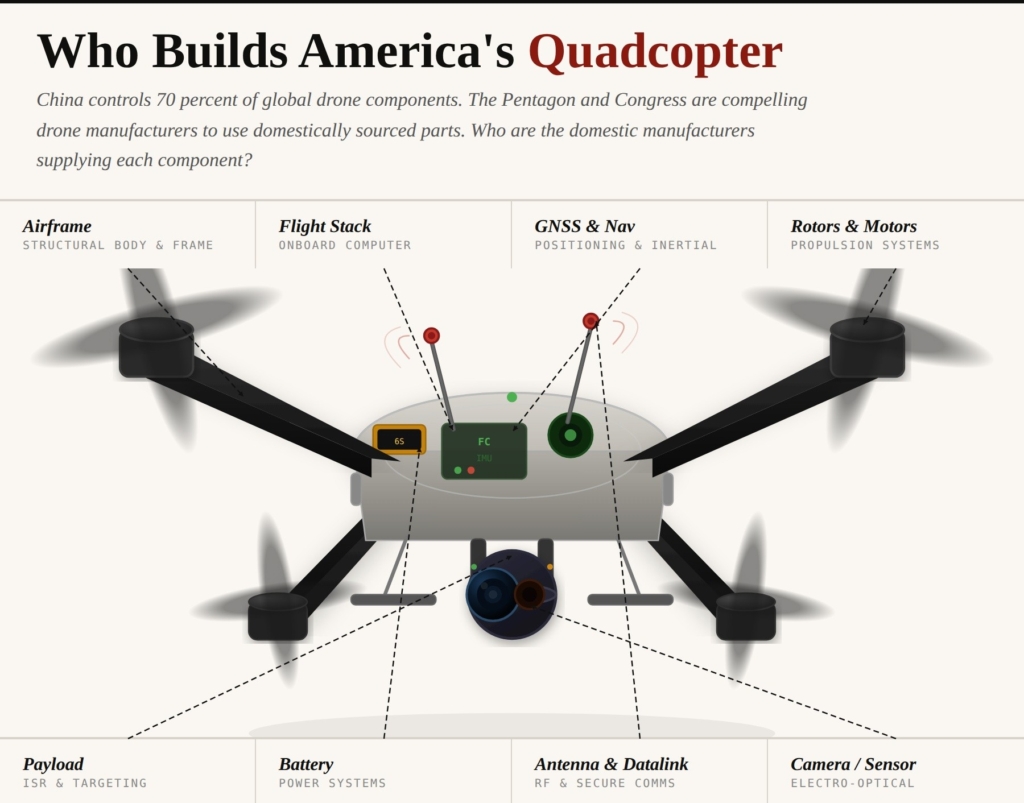
A growing debate in Washington over America's dependence on Chinese drone technology has prompted an in-depth examination of the U.S. domestic drone supply chain, breaking down a typical quadcopter into eight core component categories including airframes, batteries, flight stacks, motors, and navigation systems. The analysis draws on multiple government certification frameworks, including the Defense Contract Management Agency's "Blue List" of 67 verified ready-to-fly drones, the "Blue UAS Framework" covering 135 component suppliers, National Defense Authorization Act compliance standards, and third-party evaluations such as the AUVSI Green List. While the infographic reveals a broader American drone manufacturing ecosystem than many observers acknowledge, the authors caution that the system remains uneven, difficult to measure, and heavily reliant on self-reported compliance data in a rapidly evolving market. Key vulnerabilities persist in areas such as batteries, where China dominates mineral processing and cell production, and motors, where Chinese manufacturers can produce at a fraction of U.S. costs, though recent policy changes have begun closing regulatory loopholes. The research ultimately underscores that while the United States has meaningful domestic capacity across most drone component categories, significant gaps and dependencies remain that pose strategic risks.
Key Takeaways
- 1. The U.S. drone supply chain is broader than often portrayed, with dozens of American companies operating across eight major quadcopter component categories, though measurement remains inconsistent due to self-reporting
- 2. Batteries represent a critical vulnerability, as China controls most battery mineral processing and cell production, and has already demonstrated willingness to weaponize this leverage against U.S. companies like Skydio
- 3. A 2020 Pentagon ban on Chinese flight stacks successfully stimulated domestic alternatives, demonstrating that targeted policy interventions can effectively reduce supply chain dependencies
- 4. Navigation systems remain a weak point, with only six U.S.-domiciled companies meeting compliance criteria, despite GPS-denied environments being a near-certainty in modern combat scenarios
- 5. Multiple overlapping certification frameworks create complexity and inconsistency in verifying true supply chain security, making it difficult for policymakers to accurately assess America's real level of drone independence