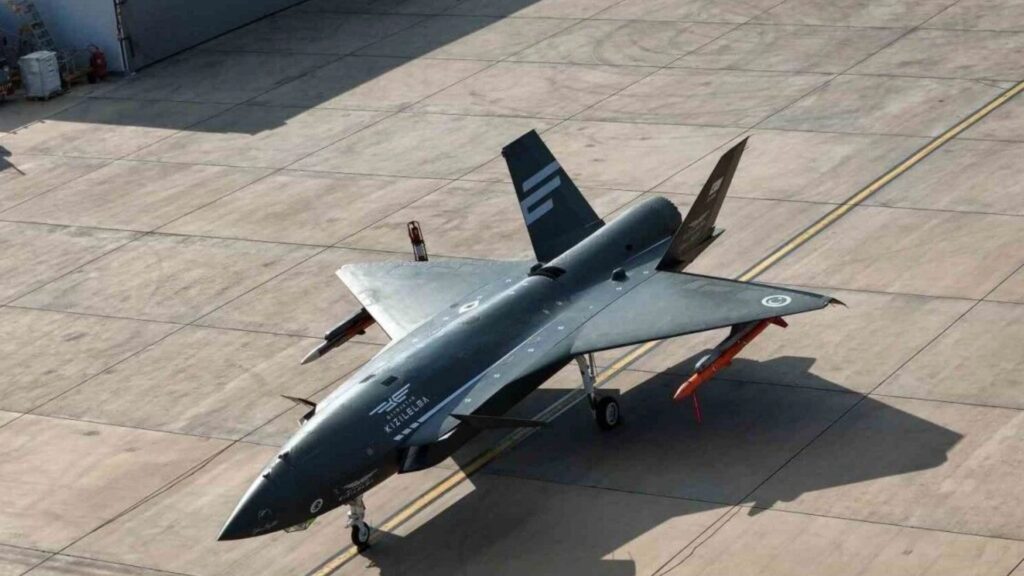
KIZILELMA Unmanned Combat Aircraft Achieves First Fully Domestic Target Acquisition and Strike Test Using ASELSAN's TOYGUN Sensor

Summary
Turkey's Baykar conducted a landmark late-June 2026 weapons test in which its KIZILELMA unmanned combat aircraft successfully located and destroyed a fixed ground target using entirely indigenous systems, marking the first time ASELSAN's TOYGUN electro-optical system served as the primary targeting sensor for the platform. The target was engaged using two guided munitions — ASELSAN's LGK-82 laser-guided bomb kit and ROKETSAN's TEBER-82 GPS/inertial/laser-guided kit — both of which are domestically developed guidance solutions fitted to standard Mark 82 bomb bodies. TOYGUN was specifically engineered for low-observable platforms, enabling target detection, tracking, and laser designation without compromising the aircraft's reduced radar signature, a capability ASELSAN's general manager described as giving KIZILELMA its "sharp eye." The KIZILELMA itself is a jet-powered, carrier-capable unmanned fighter designed for loyal-wingman operations alongside crewed aircraft such as Turkey's KAAN, featuring a low-observable design, a top speed near Mach 0.9, a combat radius of approximately 500 nautical miles, and a service ceiling of around 45,000 feet. This trial builds upon a March 2026 test and collectively demonstrates Turkey's accelerating progress in fielding a fully integrated, domestically sourced unmanned combat aviation ecosystem.
Key Takeaways
- 1. **Full Indigenous Integration Achieved:** The test represents a significant milestone in Turkey's defense autonomy, demonstrating that KIZILELMA can independently detect, designate, and strike targets using entirely domestically developed sensors and munitions without reliance on external platforms.
- 2. **Low-Observable Capability Preserved:** ASELSAN's TOYGUN system was specifically designed to perform targeting and laser designation without elevating the aircraft's radar cross-section, maintaining KIZILELMA's stealth advantage during active strike missions — a critical attribute for contested airspace operations.
- 3. **Versatile Munitions Ecosystem:** Both the LGK-82 and TEBER-82 offer considerable operational flexibility, with compatibility across NATO-standard and Russian-standard bomb bodies, GPS/laser dual-guidance, and engagement ranges up to 12 kilometres, enhancing KIZILELMA's stand-off strike utility against static and mobile targets.
- 4. **Strategic Loyal-Wingman Role:** KIZILELMA's intended teaming with Turkey's indigenous KAAN fifth-generation fighter signals a future integrated manned-unmanned combat architecture, potentially shifting regional air power balances and offering Turkey a high-end force-multiplier capability independent of foreign suppliers.
- 5. **Broader Defense Export and NATO Implications:** The milestone reinforces Turkey's positioning as a serious developer of advanced combat drone technology at a time when Ankara is simultaneously pursuing tens of billions in NATO defense contracts, strengthening both its domestic defense industrial base and its leverage in international arms markets.